
Excerpt from Chapter 3 (pictures below)
PART 1
In the 1940’s, primary school education in Ghana took ten years. (Refer to Chart 1)
The first three years may be classified as the early childhood education period. I recollect that on the first day of school in January 1940, there were about 25 of us in Class 1. There were about twenty boys and five girls. About 20 of us knew each other as we had been playing together before we reached school-going age.
Most of our parents were members of St. Thomas Church. The other five children, who did not belong to the group came from the surrounding villages. They were about two to three years older than the rest of us. However, they quickly adjusted to become part of the group.
The only significant difference about the group was that we were now wearing uniforms. The boys wore Khaki and the girls wore a yellowish dress and blue belt. There were few parents around because the teachers knew almost all our parents and we knew the teachers long before we were old enough to attend school. We knew the school grounds quite well and so there was no need for any adults to accompany us to school. We went with our older siblings. In a small town like Obuasi, the adults and children knew each other by name…
Do Teachers Count? is available for purchase at Amazon for $14.99. Click here.
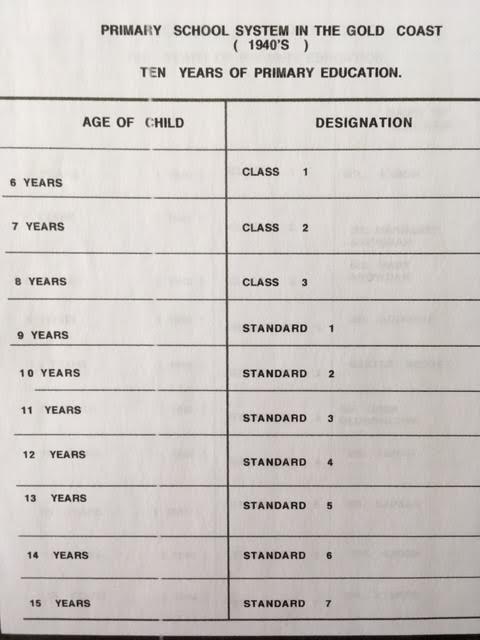
Primary School System

Part 2
The Harmattan Season (December 1940 – February 1941) was exceptionally severe.
“The Harmattan is a dry and dusty West African trade wind. It blows south from the Sahara Desert into the Gulf of Guinea between the end of November and the middle of March. The temperature can be as low as 3 degrees Celsius. Humidity drops to as low as 15 percent and can result in spontaneous nosebleeds for some. The wind can cause severe crop damage.”
My first school day in Class 2, January 1941 was a very severe harmattan day. When the bell rang at 8:30 a.m., we all lined up as usual in front of our classrooms. The teachers were there facing their pupils. This year, our teacher was Ms. Margaret Akowuah. After the prayer for the beginning of the school day, we were asked to march to our respective classrooms for the morning inspection because it was windy and quite cold. Teacher Akowuah welcomed us in a motherly way to begin our Class 2 career. She advised us to take good care of our skin during harmattan period and make sure we applied Vaseline or the local equivalent (Nku) generously on our skin. In the harmattan period, it is easy to recognize the dry, almost scaly skin of those who are not taking proper care of their skin…
 Mr. Leo Sam